题源:
Sample Exam Questions.pdf的SAMPLE SET 6。参考答案与解析由 GPT-5.5 辅助生成,并结合本站课程笔记与计算复核整理;非官方答案,仅供参考。若与课堂讲解或官方答案冲突,以官方答案为准。
Section A: Multiple Choice Questions
(1.1) Which item is correct about applying DFM in the initial design or production stage? [2]
参考答案:A
DFM 越早介入越有效,初始设计阶段变更成本最低、影响最大。
(1.2) Which is the exception among actionable sustainable design principles? [2]
参考答案:D
可持续设计鼓励延长寿命、减少资源消耗;缩短使用周期与其相反。
(1.3) Which item is not classified as an appraisal cost? [2]
参考答案:D
Appraisal cost 是评价/检验质量的成本;设备升级更接近预防或改进投入,不是 appraisal。
(1.4) Project A has NPV of USD 1.2 million; Project B has BCR of 1.035; Project C has IRR of -0.03%. Which appears most attractive? [2]
参考答案:A(需人工复核)
按题面“appears”判断,A 有明确正 NPV,B 仅略高于 1,C 为负 IRR,因此 A 最有吸引力。严格财务比较中,不同指标不能完全直接比较。
(1.5) SWOT is mainly used in project management for which item? [2]
参考答案:B
SWOT 可通过 strengths、weaknesses、opportunities、threats 帮助识别项目风险。
(1.6) An EVM report shows CPI = 1.1 and SPI = 0.9. What should we understand? [2]
参考答案:B
CPI > 1 表示成本效率好、低于预算;SPI < 1 表示进度落后。
(1.7) In a Profit and Loss statement, EBITDA/EBITA is equal to: [2]
参考答案:D
课程简化口径下,Gross Profit 减经营费用可得到扣除利息和税等之前的收益。
(1.8) If a company has the structure shown below, it is called: [2]
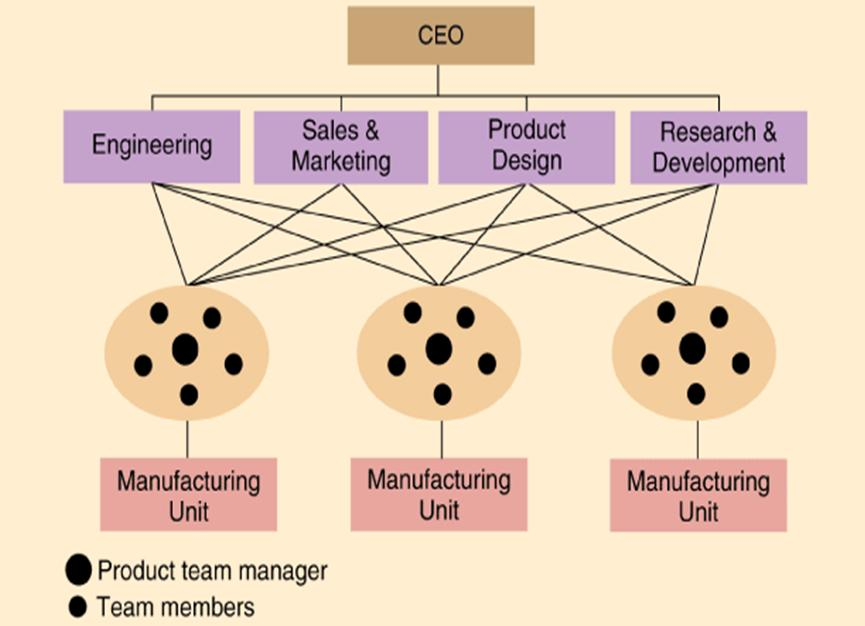
参考答案:B
图中职能部门与产品团队/制造单元之间交叉连接,符合矩阵结构。
(1.9) A Sole Trader Company is: [2]
参考答案:A
Sole trader 是个人经营、个人承担损失和责任的业务形式。
(1.10) Buying equipment costs 30,000 RMB plus 500 RMB/day. Leasing costs 2,000 RMB/day. Maximum lease time before buying is cheaper? [2]
参考答案:C
2000d = 30000 + 500d,解得 d = 20。
(1.11) What is a Profit & Loss statement? [2]
参考答案:D
P&L 表用于汇总收入、成本费用和利润。
(1.12) Defender strategic posture displays which characteristics? [2]
参考答案:B
Defender 强调稳定、效率、明确小市场和机械式集中控制结构。
Section B: Long Questions
Q2 Tower Crane, Process Groups, Leadership, EVM
Q2(a-b) Tower Crane CPM
You are a project manager working on China’s high-speed railway. A major new piece of electrical equipment must be installed at Chengdu’s new airport station using a tower crane. The collected tasks, durations, and predecessors are:
| Task | Description | Duration (days) | Predecessors |
|---|---|---|---|
| 0 | Project Start (Milestone) | 0 | - |
| 1 | Specify Crane | 3 | 0 |
| 2 | Survey Site | 4 | 1 |
| 3 | Survey Power Supply | 3 | 1 |
| 4 | Select Site | 1 | 2 |
| 5 | Order Tower Crane | 2 | 3, 4 |
| 6 | Arrange Transport | 4 | 5 |
| 7 | Order Mobile Erector Crane | 3 | 5 |
| 8 | Install Concrete Plinth | 5 | 5 |
| 9 | Confirm Site Access | 1 | 6, 7, 8 |
| 10 | Get Mobile Erector Crane on Site | 4 | 9 |
| 11 | Crane Parts on Site | 5 | 9 |
| 12 | Install Crane Base | 2 | 10, 11 |
| 13 | Install Tower & Crane Head | 1 | 12 |
| 14 | Assemble Jib | 2 | 10, 11 |
| 15 | Install Jib | 1 | 13, 14 |
| 16 | Install counterweight | 1 | 15 |
| 17 | Apply Crane Power | 1 | 16 |
| 18 | Test Crane | 1 | 17 |
| 19 | Project end | 0 | 18 |
(a) Show the information on a network diagram showing each task duration and the interdependencies. [8]
(b) Using the network diagram: list the critical path tasks in order, calculate the overall project duration, and calculate the new duration if Task 8 cannot start until Task 7 is complete. [7]
展示参考答案
One acceptable activity-on-node network diagram is:
0(0) -> 1(3)
1(3) -> 2(4), 3(3)
2(4) -> 4(1)
3(3), 4(1) -> 5(2)
5(2) -> 6(4), 7(3), 8(5)
6(4), 7(3), 8(5) -> 9(1)
9(1) -> 10(4), 11(5)
10(4), 11(5) -> 12(2), 14(2)
12(2) -> 13(1)
13(1), 14(2) -> 15(1)
15(1) -> 16(1) -> 17(1) -> 18(1) -> 19(0)
Using the network, the CPM results are:
| Task | ES | EF | LS | LF | Float |
|---|---|---|---|---|---|
| 0 | 0 | 0 | 0 | 0 | 0 |
| 1 | 0 | 3 | 0 | 3 | 0 |
| 2 | 3 | 7 | 3 | 7 | 0 |
| 3 | 3 | 6 | 5 | 8 | 2 |
| 4 | 7 | 8 | 7 | 8 | 0 |
| 5 | 8 | 10 | 8 | 10 | 0 |
| 6 | 10 | 14 | 11 | 15 | 1 |
| 7 | 10 | 13 | 12 | 15 | 2 |
| 8 | 10 | 15 | 10 | 15 | 0 |
| 9 | 15 | 16 | 15 | 16 | 0 |
| 10 | 16 | 20 | 17 | 21 | 1 |
| 11 | 16 | 21 | 16 | 21 | 0 |
| 12 | 21 | 23 | 21 | 23 | 0 |
| 13 | 23 | 24 | 23 | 24 | 0 |
| 14 | 21 | 23 | 22 | 24 | 1 |
| 15 | 24 | 25 | 24 | 25 | 0 |
| 16 | 25 | 26 | 25 | 26 | 0 |
| 17 | 26 | 27 | 26 | 27 | 0 |
| 18 | 27 | 28 | 27 | 28 | 0 |
| 19 | 28 | 28 | 28 | 28 | 0 |
Critical path:
Project duration is 28 days.
If Task 8 cannot start until Task 7 is completed, duration becomes 31 days and the new critical path includes Task 7:
Q2(c) PMI Process Groups
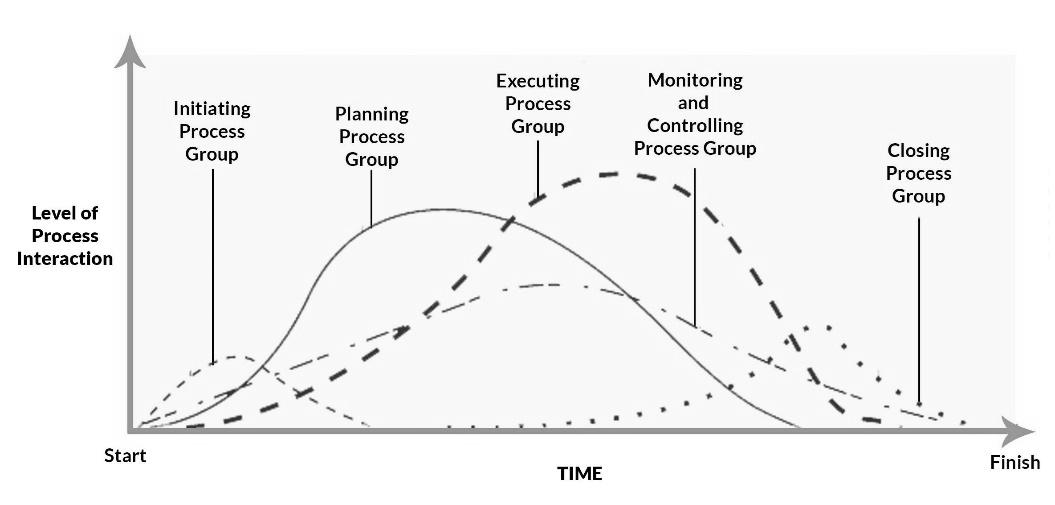
展示参考答案
| Scenario | Process group |
|---|---|
| Managing changes, recommending actions, overseeing work against plan, ensuring approved modifications | Monitoring and Controlling |
| Outlining strategies and tactics, identifying risks, documenting execution processes | Planning |
| Clarifying project purpose and scope to stakeholders | Initiating |
| Ensuring tasks are completed, obtaining approval to conclude a phase, updating documents | Closing |
Q2(d) Leadership vs Management
展示参考答案
| Leadership | Management |
|---|---|
| Focuses on vision, direction, and motivation | Focuses on planning, organizing, and controlling work |
| Inspires people and handles change | Coordinates resources and maintains stability |
| Influences commitment and culture | Monitors performance, schedule, cost, and procedures |
Both are needed: leadership helps the team want to achieve the goal; management ensures the work is structured and delivered.
Q2(e) Earned Value Management
PV = USD 10,000, EV = USD 8,500, AC = USD 8,000. Calculate SPI, CPI, and interpret performance. [3]
展示参考答案
SPI < 1 means the project is behind schedule. CPI > 1 means the project is under budget / cost efficient. Therefore, it is behind schedule but performing well on cost.
Q3 DFM, Capability, Project Management
Q3(t) DFM and Process Capability
Design for Manufacturing (DFM) includes principles such as Simplicity, Standardization, Tolerance, Material Selection, Automation, and Process Integration.
(i) In Six Sigma, explain how Poka-yoke can contribute to process improvement. Provide an example of a Poka-yoke mechanism in an LED laboratory setup. [4]
(ii) A manufacturer produces resistors with target resistance 12 ohms and tolerance ±2 ohms. A sample has average resistance 12.2 ohms and standard deviation 0.5 ohms. Evaluate Cp and Cpk. [4]
(iii) Name any two of the 4R principles for circular economy and sustainable products. [2]
展示参考答案
Poka-yoke: Poka-yoke is mistake-proofing. In Six Sigma, it reduces defects by preventing errors or making errors immediately visible. Example: in an LED laboratory setup, use keyed connectors so LED polarity cannot be reversed, or use a fixture that lights a warning LED if the circuit is connected incorrectly.
Resistor process capability: Target resistance is 12 ohms with tolerance ±2, so USL = 14, LSL = 10. Mean is 12.2, standard deviation is 0.5.
Cp = 1.33 suggests the spread is at the common minimum capability target if the process were centered. However, Cpk = 1.20 is below the common 1.33 target because the mean is shifted upward toward the USL, so the process should be re-centered and monitored.
4Rs: Any two of Reduce, Reuse, Recycle, Repair.
Q3(u) Project Management Short Questions
Project management is the application of knowledge, skills, tools, and techniques to project activities to meet project requirements.
(iv) Project managers should have three key skill sets in the Talent Triangle. Select and briefly explain any two. [4]
(v) What is the term used to describe developing a detailed description of the project and product, often represented as a hierarchical decomposition of project scope? [1]
(vi) Sarah is overseeing a new electronic device prototype. The most likely duration is 12 weeks; best case reduces duration by 3 weeks; pessimistic delay extends duration by 4 weeks. Using three-point estimating, calculate expected duration using Triangular and Beta distributions separately, and determine the standard deviation of these estimates. [4]
(vii) You manage a team of 6 members. In the next phase, 3 members are added and 2 leave. How many new communication channels need to be added? [3]
(viii) In conflict management, identify which method creates a win-win situation, which results in lose-lose, and which leaves neither side gaining nor losing. [3]
展示参考答案
Talent Triangle: Any two of technical project management, leadership, and strategic/business management. Technical PM covers tools such as WBS, schedule and risk management; leadership covers motivation, communication and conflict; strategic/business management links the project to business goals.
Detailed hierarchical decomposition: Work Breakdown Structure (WBS), or Create WBS.
Three-point estimating: Optimistic O = 9, Most likely M = 12, Pessimistic P = 16.
Triangular expected duration:
Triangular standard deviation:
Beta/PERT expected duration:
Beta/PERT standard deviation:
Communication channels: Initial team has 6 members:
After three join and two leave, team size is 7:
New communication channels added: 21 - 15 = 6.
Conflict methods: Collaborate/Problem Solve is win-win. Compromise/Reconcile is partial lose-lose because both sides give up something. Withdraw/Avoid leaves the issue unresolved, so neither side gains a substantive outcome.
Q4 Transceiver Break-even and Make-or-Buy
XYZ requires 17,500 optical transceivers annually. Supplier price is 57 RMB each. Fixed overhead is 568,750 RMB; facilities are currently rented for 225,000 RMB per year. Internal variable costs are Direct Materials 22.50, Direct Labour 12.50, Variable Overhead 2.50 RMB per transceiver. Selling price is 78.125 RMB.
展示参考答案
(a) Break-even relationship
(b) Buying scenarios
External purchase cost:
| Scenario | Purchase cost | Fixed overhead | Rental income | Equivalent annual cost |
|---|---|---|---|---|
| Facilities rented | 997,500 | 568,750 | -225,000 | 1,341,250 |
| Rental expired | 997,500 | 568,750 | 0 | 1,566,250 |
(c) Internal manufacturing
Variable cost per transceiver:
Annual internal cost:
Internal manufacturing is cheaper than buying, so XYZ should make the transceivers internally.
(d) Cost/revenue table
| Quantity | Total Cost | Revenue | Profit |
|---|---|---|---|
| 3,500 | 700,000.0 | 273,437.5 | -426,562.5 |
| 7,000 | 831,250.0 | 546,875.0 | -284,375.0 |
| 10,500 | 962,500.0 | 820,312.5 | -142,187.5 |
| 14,000 | 1,093,750.0 | 1,093,750.0 | 0.0 |
| 17,500 | 1,225,000.0 | 1,367,187.5 | 142,187.5 |
(e) Profit and safety margin
At full capacity:
Break-even quantity:
Safety margin is 17,500 - 14,000 = 3,500 transceivers, or 20%.
(f) Graph
Plot FC = 568,750, VC = 37.5Q, TC = 568,750 + 37.5Q, and REV = 78.125Q. Mark break-even at 14,000 transceivers and 1,093,750 RMB.