Lecture 02 - Fundamental Concepts in Optimization
1. Exam Focus(真题对齐)
High-frequency (A 档)
- Engineering problem formulation (6-step procedure)
- 2022-2023 Q2(a): formulate antenna design into an optimization problem
- 2023-2024 Q1(a): list objectives (if any) and constraints (if any) for filter design
- 2024-2025 Q2(a): define decision variables (how many? type? range?) for a defense optimization tool
- Objectives vs constraints; feasible/infeasible; comparing solutions (constraint violations)
- 2022-2023 Q1(d): concepts of objectives/constraints/feasible solutions
- 2023-2024 Q1(a)(b): objectives/constraints + integrate them (integration handled later, but classification is from this lecture)
- 2024-2025 Q1(a)(b): number of objectives/constraints; integrate constraints into a single function
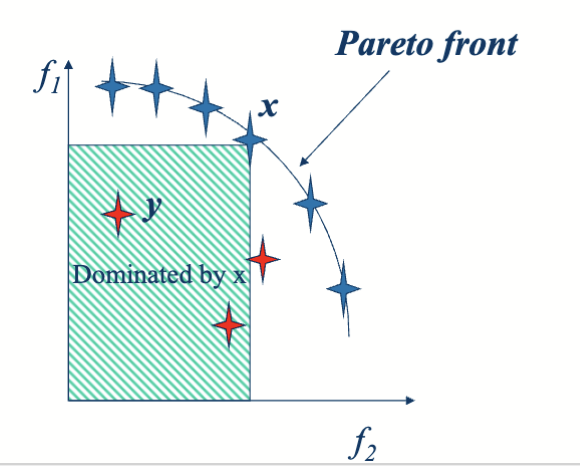
- Multi-objective optimization: domination, non-dominated, PF/PS (PF = F(PS)); compare Pareto fronts
- 2022-2023 Q1(e): Pareto optimal / PS vs PF / non-dominated
- 2023-2024 Q2(a)(b): choose multiobjective vs constrained single objective; compare two PFs
- 2024-2025 Q2(b): compare PFs (minimization)
- Decision-variable representation (continuous / binary / permutation) + search space
- 2024-2025 Q2(a): “m or n variables?”, “continuous/binary/permutation?”, “range?”
- 2023-2024 Q2(c): delivery plan solutions are permutations (representation is prerequisite)
Medium (B 档)
- Global vs local optimum; local vs global optimization; neighborhood
- 2022-2023 Q1(b): hill climbing is local search (ties to local optimum & neighborhood)
- Unimodal vs multimodal
- 2022-2023 Q1(h): multimodal means >1 local optimum
Low (C 档)
- Engineering case study details (antenna array, network slicing, etc.)
- Usually not directly examined; used as modeling examples.
Scoring checklist(本节课拿分点清单,可直接背)
- Can write the generic optimization form: variables + objective(s) + constraint(s) + search space
- Can apply the 6-step procedure to translate text specs → math model
- Can correctly distinguish objective vs constraint
- Can rank solutions: feasible(可行解) > infeasible(不可行解); infeasible vs infeasible uses violation
- Can define domination (min/max), identify non-dominated set, and explain PF/PS (+ PF=F(PS))
- Can compare two Pareto fronts using convergence + diversity/coverage
- Can state decision-variable representation (continuous/binary/permutation) and ranges
2. Key Concepts(知识点)
A 档(必会)
(A1) 6-step procedure: formulate engineering problems into optimization problems
- Identify requirements
- Classify requirements to objectives and constraints
- Identify decision variables and their properties (type: continuous(连续)/binary(二项分布)/permutation(排列)/...)
- Identify search space (ranges / feasible domain)
- Identify if there is a starting point
- Identify how to obtain objective and constraint values (simulation/measurement)
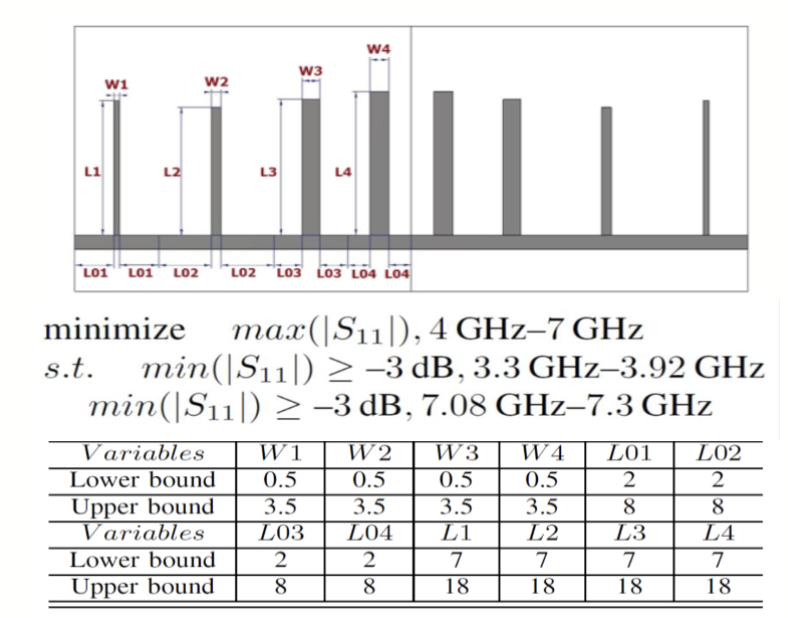
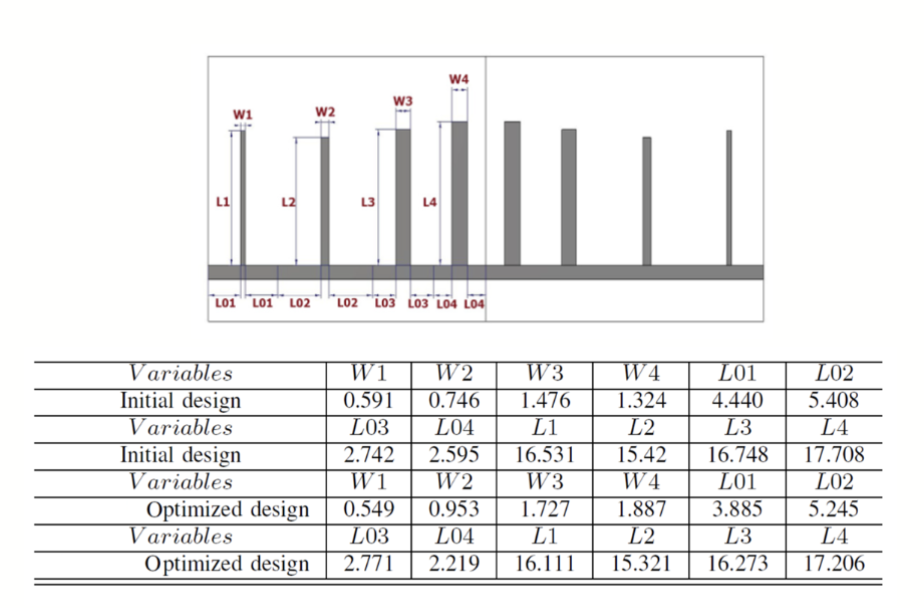
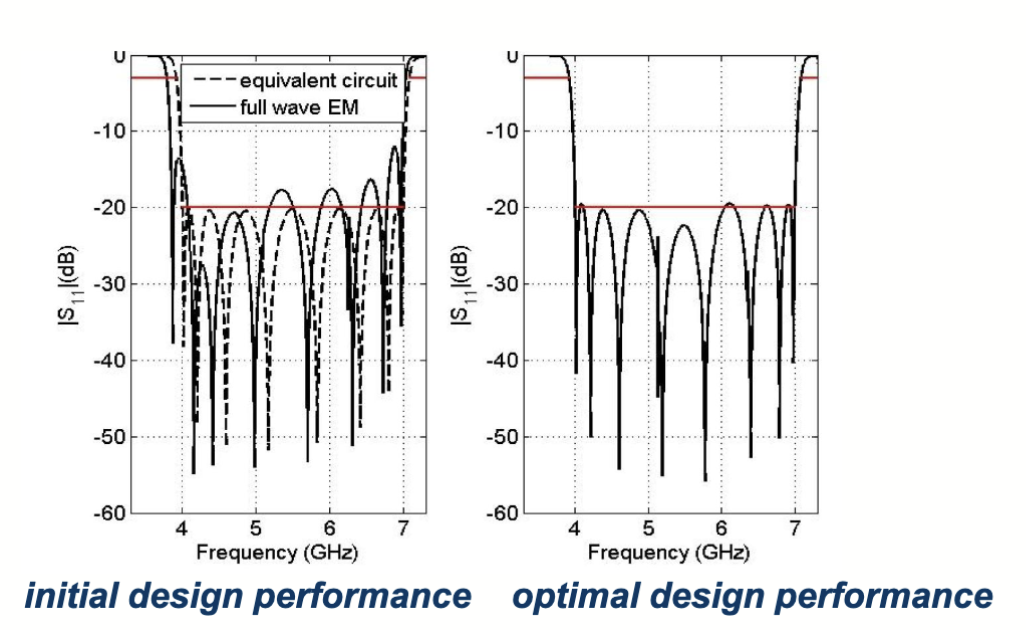
(A2) Objectives vs constraints; feasible space; comparing solutions
- Decision variables : (X)
- Objective : optimize (min/max)
- Constraints : must satisfy (feasible/infeasible)
- Feasible space : set of all solutions satisfying constraints
- Comparing solutions (PPT rule)
- Two feasible: compare objective
- Feasible vs infeasible: feasible is better
- Two infeasible: compare constraint violations (smaller violation is better)
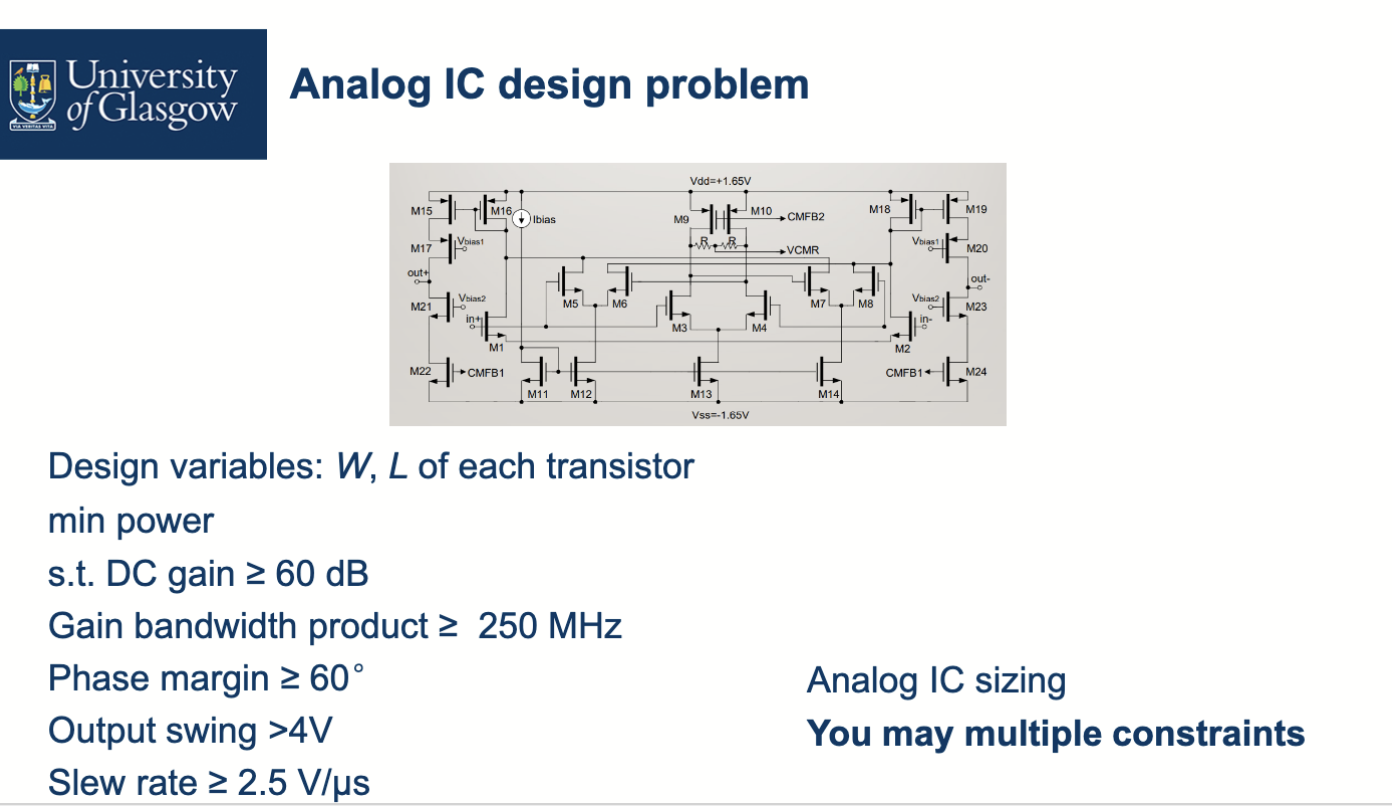
(A3) Multi-objective optimization; domination; Pareto front / Pareto set
- Multiobjective form:
- Domination (example for maximization; for minimization flip the inequalities):
- Pareto-optimal (non-dominated): not dominated by any other solution
- Pareto set (PS): Pareto-optimal solutions in decision space
- Pareto front (PF): objective vectors of PS in objective space
(A4) Decision-variable representation + search space
- Binary :
(feature selection / knapsack selection) - Permutation :
is a permutation of (TSP/QAP) - Continuous :
, each with bounds
B 档(可能考)
(B1) Global vs local optimum; neighborhood
- Global optimum (max case):
- Neighborhood
: points considered "close" (definition depends on problem: Euclidean/Hamming/swap) - Local optimum: best within (\mathcal{N}(x))
(Old-note image preserved) 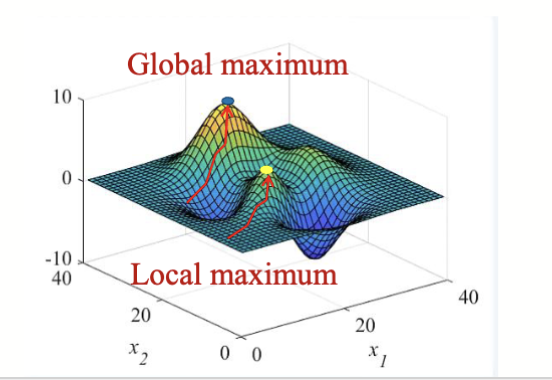
(B2) Unimodal vs multimodal
- Unimodal: single optimum basin
- Multimodal: multiple local optima (local search can get stuck)
C 档(低频)
- Case-study-specific domain details (antenna/network slicing/radar features): know they are examples of modeling, not memorization targets.
3. Must-know Formulas / Algorithms(公式/算法模板)
3.1 Constrained optimization template(可抄)
3.2 Comparing solutions in constrained optimization(PPT rule)
- Feasible vs feasible: compare objective value
- Feasible vs infeasible: feasible is always better
- Infeasible vs infeasible: compare constraint violation (smaller is better)
(Optional violation scalar you can write if needed)
3.3 Domination & Pareto (2-objective)
- (Max case) domination:
- PF/PS relation:
3.4 6-step procedure(流程编号,答题直接写)
- Requirements list
- Objective(s) + constraint(s)
- Decision variables + type
- Search space/ranges
- Starting point?
- How to compute objective/constraints (simulation/measurement)
4. Worked Examples(例题与解答)
Note: These are “exam-style” and aligned to past papers’ wording.
A1 Example 1 — Filter design (formulation)
Problem
Given passband and two stopbands specs with S11(dB), formulate min problem with objective & constraints, define
Solution :
- Variables:
- Objective:
- Constraints:
- Search space:
- Evaluation: EM simulation → extract S-parameters → take max/min over bands
Final Answer
Write the above min/s.t. +
A1 Example 2 — Antenna design (formulation)
Problem
Band 1.1–1.7 GHz: require
Solution :
Final Answer
Objective = size; constraints = two band-max specs;
A2 Example 1 — Compare solutions (feasible > infeasible)
Problem
Solution
Compute
Final Answer
Best solution:
A2 Example 2 — Rank by constraint violations
Problem
Min problem with
A:
Solution
Feasible beats infeasible ⇒ B best.
Among infeasible, compare violation sum
Final Answer
B > A > C.
A3 Example 1 — Find PF (minimization)
Problem
Given several (f1,f2) points, find non-dominated set.
Solution
Use min-domination:
Final Answer
Remaining points are PF.
A3 Example 2 — Compare two PFs (8-mark style)
Problem
Two algorithms produce two PFs (min). Compare.
Solution :
- Convergence: closer to left-bottom is better
- Diversity: wider coverage + more uniform spacing is better
Write 3–5 sentences using these keywords.
Final Answer
A complete comment must mention both convergence and diversity/coverage.
A4 Example 1 — Representation & ranges
Problem
Feature selection / TSP / network slicing: specify variable type and range.
Solution :
- Feature selection:
- TSP: permutation of
- Network slicing: continuous
Final Answer
State variable count (n), type, and range.
A4 Example 2 — Swap neighborhood (permutation)
Problem
For
Solution
There are
Final Answer
(3,2,4,1), (4,3,2,1), (1,3,4,2), (2,4,3,1), (2,1,4,3), (2,3,1,4)
5. Common Mistakes(易错点,扣分点 ≥10,按重要性排序)
- 把“必须满足的规格”误写成目标(却不说明多目标/不写处理方式)
- 忘写搜索空间
或变量范围(缺“可优化的域”) - 频段指标是向量却没写“max/min over band”(缺“向量 → 标量聚合”)
- 可行/不可行比较规则写反(应:feasible > infeasible)
- 两个不可行解不比违约程度,反而比目标值(规则错)
- Domination 忘了“至少一项严格更好”
- min/max 方向搞反,导致 PF 全错
- 把 Pareto set 当 Pareto front(PS 在决策空间,PF 在目标空间)
- PF 比较只写“算法 2 更好”不给依据(必须写 convergence + diversity/coverage)
- TSP/QAP 误用二进制/实数表示且不加可行性约束(表示法错误)
- 邻域定义混乱(swap vs adjacent swap;欧氏 vs Hamming)
- 把 multimodal 误解成“多变量/多目标”,而不是“多个局部最优”
6. Quick Review(考前 10 分钟速记)
6.1 必背模板(3 行写完建模)
- 先写:变量(个数/类型/范围)
- 再写:目标(越大越好 or 越小越好 + 频段用 max/min 聚合)
- 最后写:约束(必须满足的规格)
6.2 6-step procedure(背到能默写)
- Requirements
- Objective(s) + constraint(s)
- Variables + type
- Search space/ranges
- Starting point?
- Evaluation method (simulation/measurement)
6.3 Constrained ranking(PPT 原规则一句话)
- feasible > infeasible;feasible 之间比目标;infeasible 之间比违约
6.4 Pareto(两句拿满分)
- domination:所有目标不差 + 至少一个更好
- PF:所有非支配点集合;PS 在决策空间,PF 在目标空间,且
6.5 PF 对比(8 分关键词)
- Convergence(更靠近理想点) + Diversity/Coverage(覆盖更宽、更均匀、不扎堆)